
The Last Supper is full of contrasts, especially when you look at the disciples and the state they were in. On one extreme is Judas. I imagine the meal was filled with anxiety for him. He might have been second-guessing his decision, carrying the weight of what he had already set into motion. And yet, Jesus still washes the feet of his future betrayer. (I wrote about this last year in a post called “He Still Washed His Feet”.
The table is filled with very different kinds of people: betrayers, doubters, and those who simply want to be near Jesus.
The Characters
You have someone like Thomas. Jesus’ exhortation at the beginning of John 14 is crucial, as he describes how his death will open the way to eternity.
Upon hearing this, Thomas replies, “Lord, we do not know where you are going. How can we know the way?” (John 14:5, ESV)
Then there is John. After the foot washing ceremony in John 13, you read, “One of his disciples, whom Jesus loved, was reclining at the table at Jesus’ side.” (John 13:23, ESV)
But in other translations, more details emerge about John’s experience at the Last Supper.
“One of his disciples, the one Jesus loved, was at the table to the right of Jesus in a place of honor.” (John 13:23, NET)
This highlights that John was right beside Jesus, a place of honor at a table for their context. Either side, right or left, was a valuable spot to be sitting..
But there’s even more going on here…
John’s Experience
“Lying back on Jesus’ chest was one of His disciples, whom Jesus loved.” (John 13:23, NASB)
The phrase “lying back on the chest” is what we see in the Greek here, and it was the word-for-word translation that the NASB wanted to hold to. Some translations smooth this out for readability, but the original language preserves a striking scene.
We are familiar with Leonardo da Vinci’s painting of the Last Supper, but with any piece of art, not all of the historical details are accurate. Looking at this detail, Da Vinci did not include this moment with John.
I recently came across another painting of the Last Supper, done by a nun named Plautilla Nelli in the 16th Century. (You can read more about it here) She included this moment between John and Jesus.
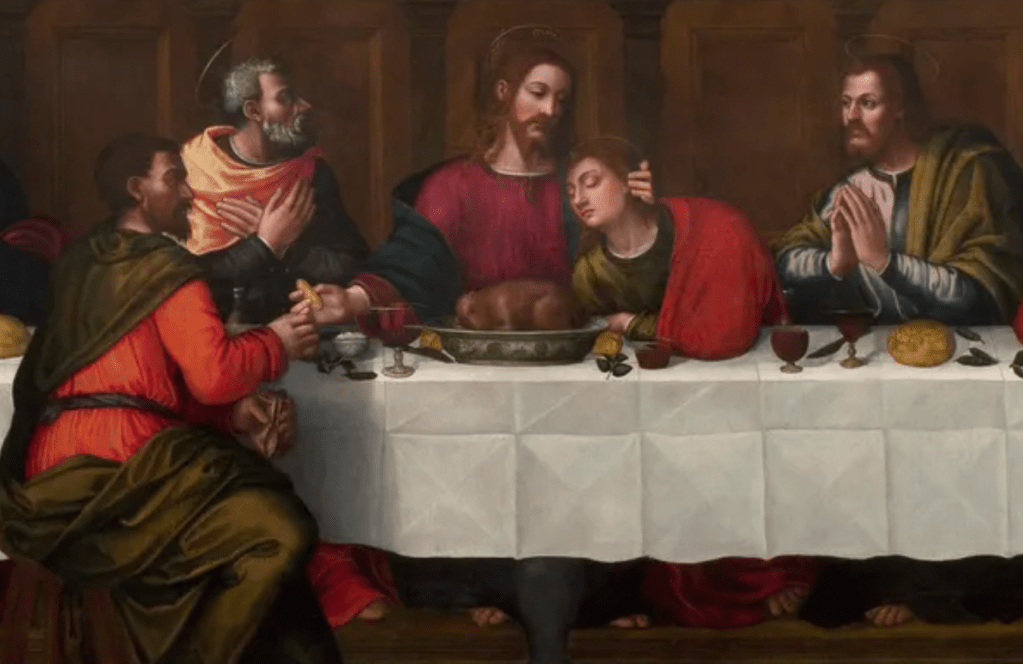
It seems to me that John was keenly aware of the love that Jesus had for the disciples and for all of creation. Not only does he refer to himself as “the disciple whom Jesus loved”, but he is the one who wrote more about Christ’s love than any other New Testament author.
1 John provides a rich concentration of statements on Christ’s love:
- 1 John 4:8 – “God is love”
- 1 John 4:7 – “Let us love one another”
- 1 John 4:19 – “We love because he first loved us”
- 1 John 3:1 – “See what kind of love the Father has given us…”
- 1 John 3:16 – “By this we know love, that he laid down his life for us”
- 1 John 4:9 – “God’s love was made manifest…
- 1 John 4:10 – “Not that we loved God, but that he loved us”
- 1 John 3:10–11 – “We should love one another”
The list could continue. And we can’t forget John 3:16, “For God so loved the world…”
John doesn’t just understand Jesus’ love, he experiences it. He positions himself close enough to feel it, to rest in it for a moment, and to remember it. Not that it was hidden from the others, but it was something so real to John in his experience with Jesus. I wonder if he had a deeper understanding of what was about to take place.
The act of lying back on a friend’s chest might seem odd to us. My kids do that to me, but a friend?! The phrase used in the Greek leads scholars to believe that this was a very normal posture for friends in the 1st Century.
The Jesus who welcomed John’s posture is the same Jesus who still draws near to us. If he were here today, He would listen to us. He would put his arm around us. He would tell us, “It’s going to be okay. I love you. I am the way, the truth, and the life.”
He meets us in our anxiety like Judas, our confusion like Thomas, and our longing like John.
And that’s my prayer for you this Maundy Thursday. That you would be utterly convinced that Jesus is who he says he is, and that you would know that you are so loved by him.
On this Maundy Thursday, we remember that Jesus gave a new command: to love one another.
Let us love because He first loved us.
Reflection
- Which seat at the table do you find yourself in right now?
- Name moments in your life in which you have experienced the love of Jesus in a real way.
- Meditate on the characters of the story, while remembering that Jesus went to the cross for each one of them.
- Pray and thank Jesus for His love for you.
- In prayer, confess and ask for forgiveness for how you find yourself denying Jesus, doubting him, but then tell Jesus that you still love him through it all.

by Craig Archer
Craig is a worship pastor at Wallula Christian Church and the creator of Active Theology. He loves coffee dates with his wife, reading, and riding his bike. A few of his favorite things are third wave coffee, vanilla ice cream, and plain t-shirts.
 Active Theology
Leave a comment