
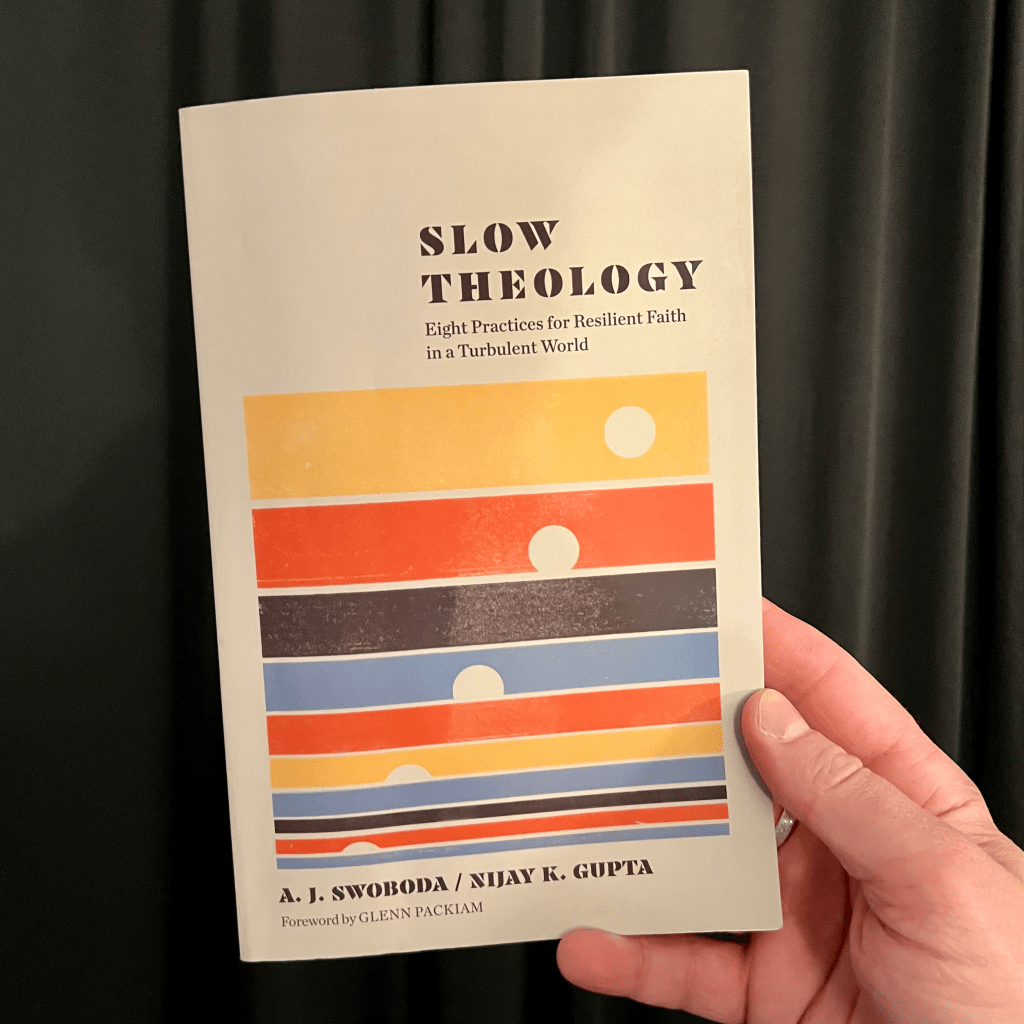
Our world is easily prone to outrage, hurry, and having the answers for everything. When the news breaks of another tragedy, people are quick to anger and want to figure out who is right, instead of lamenting and letting their hearts break. Our culture champions the lone ranger and applauds those who make it to the top. Slow Theology is both a response and an invitation: to slow down, resist the rush to certainty, and relearn how to listen for God’s voice.
Overview
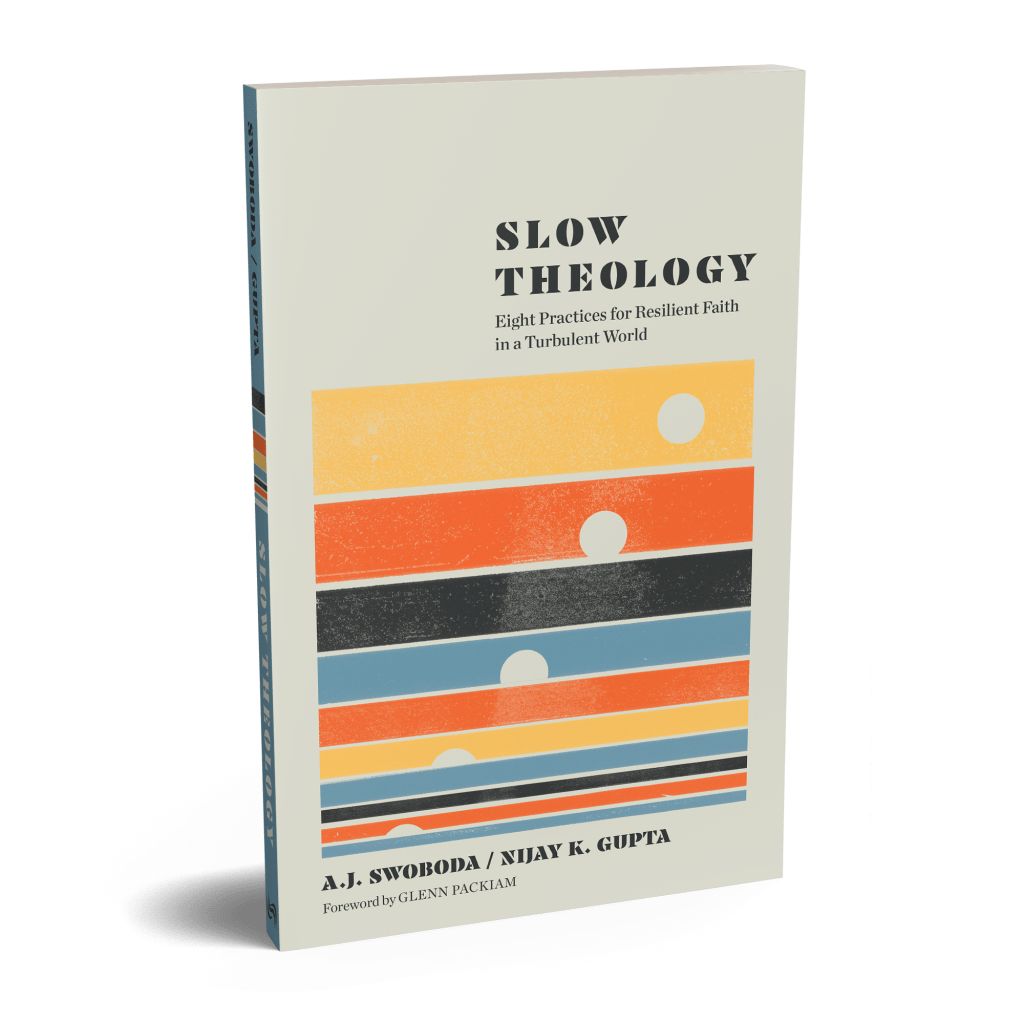
This timely book offers a fresh perspective on how to remain steadfast in your faith despite the cultural climate and current speed of life that surrounds us. The release of this book fits well into the wave of spiritual formation books that has surged in recent years, while holding its own with unique content and ideas. Co-authored by A.J. Swoboda and Nijay Gupta, the book seems to be a result of their 4 years of hosting a podcast that holds the same name, Slow Theology.
As the book begins, they set forth their goal by saying…
“This book seeks to offer our readers eight biblically and theologically informed practices for how they can develop a faith that withstands the many challenges of the present world. Our conviction is that these challenges we face can, if walked carefully, make us deeper followers of Jesus.”
I love the premise of viewing the challenges we encounter as opportunities to grow and consider how God would have us handle situations, because that is where growth and formation can take place.
The book covers eight practices that are counter-cultural to our fast-paced, individualized world. What are the practices?
- Take Your Time: Learn to Linger with God
- Embrace the Theological Journey: Take the Long View of Faith
- Think Slowly: Applying Sabbath to Our Theology
- Ponder the Mysteries: Answers Aren’t Always the Answer
- Go to the Problems: Challenge Yourself to Not Run from the Difficulties
- Let Pain Be the Altar: Talking to God Through Our Difficulties
- Believe Together: One Faith, One Body, Communal Theology
- Don’t Ever Give Up: Those Who Make It to the End Will Win
We all know that our culture is quick to avoid and ignore struggle, but this book aims to change that. Slow Theology holds much wisdom for the reader and offers an invitation to do things such as face problems head-on, enter into community, and embrace the long, slow journey of following Jesus.
Strengths
Accessible to Readers
This was my first time reading Swoboda and Gupta, so I didn’t know what to expect from their writing style or presentation. Knowing that both are Bible college professors (and the book has the word theology in the title), I was expecting there to be a slightly academic feel in the writing, but I experienced the opposite. I didn’t find pretentious theological words or rants on eschatology. Instead, I was greeted by a well-crafted book that gave the confidence of strong biblical theology, with the ability to portray biblical truths in a very digestible way. I did love the quick theological lesson squeezed in every once in a while.
I recently had a friend describe Swoboda’s writing style as “down to earth”, and that is very accurate to this book. The authors did an excellent job of making this book accessible to a wide range of readers, those new to Christianity and those who have been following Jesus for 50 years. When it gets down to it, this book offers a “how-to” approach to the act of thinking and meditating on God and Scripture, and it’s done in a way that’s beneficial for all types of readers.
Counter-Cultural Rhythms
When you look through the chapter headings, you realize there is gentle pushback to how humans tend to live. They offer practices that suggest slowing down, feeling okay that you won’t always have the answers, not running from difficulty, and letting others influence how you think about God. Even just reading that list, don’t you feel some slight tension?
I found myself being encouraged, but also slightly relieved and feeling like it’s okay to loosen my grip on some things in my life. I tend to want to have all the answers, and I want to have them now. So the chapter titled “Ponder the Mysteries” caused me to do a little work on myself and let go of the tension of having all the solutions and explanations.
Points of Critique
Lack of Practical Application
The book is full of wisdom that can be applied to the readers’ lives, but I found myself wanting more in the case of real-life examples from the author. With the authors being college professors, there were plenty of examples from their students being busy and caught up in the frantic pace of life, but I wanted to see more ways to put the ideas into practice. With a subtitle like “Eight Practices…”, it made me assume there would be more practical steps.
It makes me think about when I preach sermons, I tend to get toward the end and always ask myself, “What’s the application here? How will the congregation live out the truths of this passage?” I naturally want to give people a next step.
For this book, I really loved the chapter Believe Together and the encouragement it brought for why it’s better to form and build our beliefs when we are surrounded by a community of other believers. I absolutely agree!
I think of someone new to their faith who is struggling to connect with other believers. Or maybe it’s the person in a season of questioning and doubt that could use a practical step to move forward. Maybe it’s the burnt-out leader who can’t stand another meeting, so they shy away from gathering together. I would have loved to see a few “next steps” that people could take.
Salvation vs Sanctification
There is one section that I personally found confusing. (I wish I could sit down and talk this through with them!) In the first chapter, Take Your Time, they present the idea of conversion and salvation. The authors state that conversion is the moment of deciding to follow Jesus – I agree. They then state that “salvation is the lifelong process journey of becoming more and more like the image of Christ through the power of the Holy Spirit.” I asked friends what this lifelong process is called, and everyone said the same thing: sanctification. They base this definition of salvation on Scripture (1 Cor. 1:18; 2 Cor. 2:15), but I still found myself slightly confused.
They finish this section by saying that we are not ready to handle the incredible future-gift of reigning with Christ in the new heavens and new earth because this lifelong process of formation must take place beforehand. (College students don’t get the degree until they’ve completed the work, right?) But I wrote in the margin…what about the thief on the cross? For some reason, this section had me scratching my head and wanting to sit down with the authors to find clarity.
And just so you know, this wasn’t sounding a theological alarm for me, but more so a personal choice in words and categories. This isn’t a disagreement so much as a desire for clearer theological categories.
This is a rant about where my mind went as I read this section. It truly doesn’t take away from the book, but more so, I just want more clarity on the author’s thoughts here.
Conclusion
This is a wonderful book that comes at a perfect time in our world. When the world feels fast-paced, overstimulating, and exhausting, this book offers a much better path as long as the reader is willing to give it a try and embrace the challenge. For the new Christian, the skeptical, the one questioning, or the believers in need of encouragement to remain steady, this book has something for everyone.
It’s a challenge to slow down, embrace difficulties, and let God shape and form you over the course of your life. If any part of you feels weary from speed, certainty, or self-reliance, this book offers a thoughtful invitation to slow down and let God do the long work of formation.
Thank you to Baker Publishing Group for sending me a copy in return for an honest review!

by Craig Archer
Craig is a worship pastor at Wallula Christian Church and the creator of Active Theology. He loves coffee dates with his wife, reading, and riding his bike. A few of his favorite things are third wave coffee, vanilla ice cream, and plain t-shirts.
 Active Theology
Leave a comment